Bismillahi Ar Rahmani Ar Raheem

It was a time when autumn had made its arrival unmistakable. The trees had become branches outstetched and bare. Once a leafy canvas, now blown away after being stripped of moisture and colour. I had once been warned that autumn, more than winter, was to be feared—that it was the more deceptive and the more devastating season. Autumn disguised itself with its warm sun fooling you, but its crisp breezes quietly dried leaves and transformed trees once so vibrant and overcrowded, hollow and barren.
At that time, I did not care too much about that warning.
When the cloth began to thicken and the windows were no longer inviting the outside in, I took a misguided walk one evening and began to notice the intruding blows that were carrying the brittle remains of fallen leaves crackling all around. It felt as though it passed through my clothes, penetrated my skin, and wrapped itself around my bones. I suddenly felt shivers and regretted my decision to indulge in that evening promenade. Wrong place or wrong time, something felt not quite right. I rushed home and decided to try to undo whatever had taken hold. I stepped into a steaming hot shower and thought that would somehow exile the cold that felt like it occupied me suddenly. It seemed to help only for a while. That autumn remains, to this day, the most unsettling and uncomfortably harsh autumn I have ever endured.
▪︎▪︎▪︎▪︎▪︎▪︎▪︎▪︎▪︎▪︎▪︎▪︎▪︎▪︎▪︎▪︎▪︎▪︎▪︎▪︎▪︎▪︎▪︎▪︎
The wind has been an element of discussion and practice for centuries. The Ancient Greeks worshipped 4 wind gods: Boreas (north), Zephyrus (west), Notus (south), and Eurus (east). Euros (Southeast Wind) and Kaikias (Northeast Wind) were also prayed to. Each one was associated with a specific season and weather pattern. They were frequently invoked by sailors and farmers in need of favourable weather conditions to help with their crops and travels across sea. 1
In the ancient island of Tierra del Fuego, the southern most point of South America, Feugian wizards, known as sorceres or shamans would throw shells at the wind to make it stop. This was documented in the anthropological account of Sir James Frazer (1854–1941) entitled “The Golden Bough” (1922).
He also notes that in Greenland, it was believed that women who had just had a baby possessed the power to conjure a storm. A woman only needed to step outside, fill her mouth with air and step back inside and blow it out of her mouth.
Later, the witches and wizards of Lapland, Shetland and the Island of Man began mastering the art of tying knots as early as the thirteenth century. Lapland refers to Norway, Sweden, Finland, and Russia. Shetland is located between Scotland and Norway. The Isle of Man is in the Irish Sea. 2
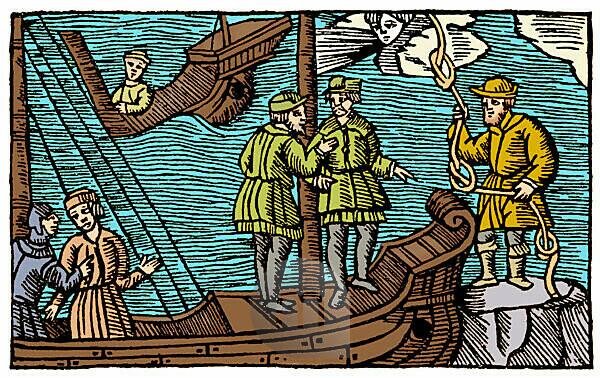
Sailors regularly bought strands of “wind knots” from witches who made a good living out of the art. Witches and wizards were able to “collect” winds of various intensities on mountain tops and trap them in knots. Three knots were made on a single strand and sold to the captain of the ship. At sea, the captain would untie a single knot for a gentle breeze to form, two for a half of a gale, and three knots for a massive storm. 3
The image below shows a Finnish wizard selling wind knots to a captain. It was created by Olaus Magnus (October 1490 – August 1, 1557) in his 1555 work “A Description of the Northern Peoples”. 4 The ship in the back is sinking as the third strongest knot was untied which according to their craft, is highly risky.
In New Guinea, wind making was accomplished by striking a “wind-stone” very lightly with a stick as beating it with force could cause a hurricane. Scotland witches were reported to have accomplished this by using a rag that was dipped in water and striking a stone with it three times. They would then say:
“I knok this rag upone this stane
To raise the wind in the divellis name,
It sall not lye till I please againe.”5
Interestingly enough, it is clear with the above spell that the devil is being invoked rather than some energy or nature god.
The Estonians who are separated from Finland by the Gulf of Finland were very wary of the magic caused by their Northern Finnish neighbours according to folk tradition. Ancient Estonians were reported to have fear of three days in particular in the spring which they call “Days of the Cross” or Ristipäevad. 6 They avoided going outside on those three days for fear of actual death. They believed that the winds from the north brought with them fever and rheumatic inflammations. A popular Estonian song goes:
Wind of the Cross! rushing and mighty!
Heavy the blow of thy wings sweeping past!
Wild wailing wind of misfortune and sorrow,
Wizards of Finland ride by on the blast.7
Clearly the above explanation shows that windcraft was a form of witchraft and wizardry and carried with it change and disease. The ones who were able to harness the power of the wind were also feared, but respected as the sailors needed them.
Witchcraft and windcraft appear in Shakespeares works too. Shakespeare’s “The Tempest” begins with a violent storm (tempest) conjured by Prospero with the help of Ariel a spirit, in the name of vengeance, chaos, and a disruption of natural order.8
In Macbeth, Act 1, Scene 3, Shakespeare describes witches who are proud of their abilities with one promising to “Give thee a wind“. 9
In Macbeth Act 4, Scene 1, Shakespeare writes: “Though you untie the winds and let them fight / Against the churches” and continues describing the level of destruction that winds are capable of from sinking ships, to destroying crops, toppling castles over and even sloping pyramids among others . 10
To put it symply, “wind magic” harnesses the power of the wind and uses it as a means of communication and change. Storm witches can utilize the wind to carry their intentions far and wide. In other words, the wind is considered like a transporter of their intentions and desires. 11
In Chinese folklore, the wind is a powerful, often pathological force known as Feng (风). It is viewed as a carrier or “evil” pathogen that can bring fortune or disaster and of course disease. 12
Women in partcular are especially vulnerable to cold and wind and are advised to keep very warm.13 In general, traditional Chinese medicine encourages everyone to keep vital organs warm and to consume warm soups and drinks during the changing of seasons. 14
In Islam, the wind is firmly believed to be originating from Allah and Allah only. It is also considered one of Allah’s armies. Regardless of whether it is coming from the hands of magic or not, Allah is the one who allows it. This hadith from the prophet Muhammad (s) sheds light on the concept of wind in Islam,
‘Ibn ‘Abbas narrated that a man cursed the wind in the presence of the Prophet, so he said:
“Do not curse the wind, for it is merely doing as ordered , and whoever curses something undeservingly, then the curse returns upon him.”15
It was also narrated from Abu Hurairah that the Messenger of Allah(ﷺ) said:
“Do not curse the wind, for it is from the mercy of Allah, bringing Rahmah (i.e., rain and breezes), or destruction. But ask Allah for its goodness, and seek refuge with Allah from its evil.”16
Another hadith shows how the wind would also bring about a change in the prophet Muhammad(s) mood.
‘A’isha (r) said,
“I never saw the Prophet, may Allah bless him and grant him peace, laugh until I could see his uvula. He used to smile, may Allah bless him and grant him peace.” She said, “When he saw a cloud or wind, distress could be seen in his face.” She said, “Messenger of Allah, when people see a cloud, they are happy, hoping that there will be rain in it. Yet when you see it, I see distress in your face.” He replied, “A’isha, what will assure me that there is no calamity in it? People have been punished by wind. Some people saw the punishment and stated, ‘This is a rain cloud coming to us.”17
“People” here are actually the people of Ad. They turned to idolatry after many warnings and were destroyed by a cold icy wind that raged for 7 days and 8 nights. 18
The prophet(s) appeared to be distressed so much during windy weather that he would be seen looking very restless and moving in and out of the house. He instructed us to say the below supplications when there was wind and/or rain.
اللَّهُمَّ إِني أَسْأَلُكَ خَيْرَهَا ، وَخَيْرِ مَا فِيهَا ، وخَيْرِ ما أُرسِلَتْ بِهِ ، وَأَعُوذُ بك مِنْ شَرِّهِا ، وَشَرِّ ما فيها ، وَشَرِّ ما أُرسِلَتْ بِهِ
It was Narrated by Muslim from ʿĀʾisha (raḍiyAllāhu ʿanhā), who says that the Prophet (SAW) would recite this words whenever strong winds would blow. It means O Allah, I ask you for its benefits, the good within it, and the good it brings. I seek Your Protection from its harm, the harm within it, and the harm it may bring.
Another supplication would be:
اللَّهُمَّ إني أَسْأَلُكَ خَيرَهَا، وَأَعُوذُ بِكَ مِنْ شَرِّهَا
O Allah, I ask you for its good, and seek Your Protection from its harm. (Ibn Mājah)19
The below hadith shows that the prophet(s ) also read qur’an when he was afflicted with windy weather.
ʿUqba b. ʿĀmir narrates that once I was traveling with the Prophet (SAW), and we were suddenly hit by strong gusts of wind, and dark clouds enveloped us. The Prophet (SAW) began reciting sura al-Falaq and sura al-Nās, and said, ‘O ʿUqba, read them for protection, no one can take protection with anything like them [because they are the most effective protection]. (Abū Dāwūd)20
If you are someone who is not aware of surah Al Falaq and surah Al Nas, then you should be enlightened by some of these facts. These two surahs are some of the most powerful protections muslims have against evil in all its forms. Together they form the Mu’awwidhatayn (the two surahs of refuge) providing the best protection against magic and the evil eye.
Surah Al Falaq
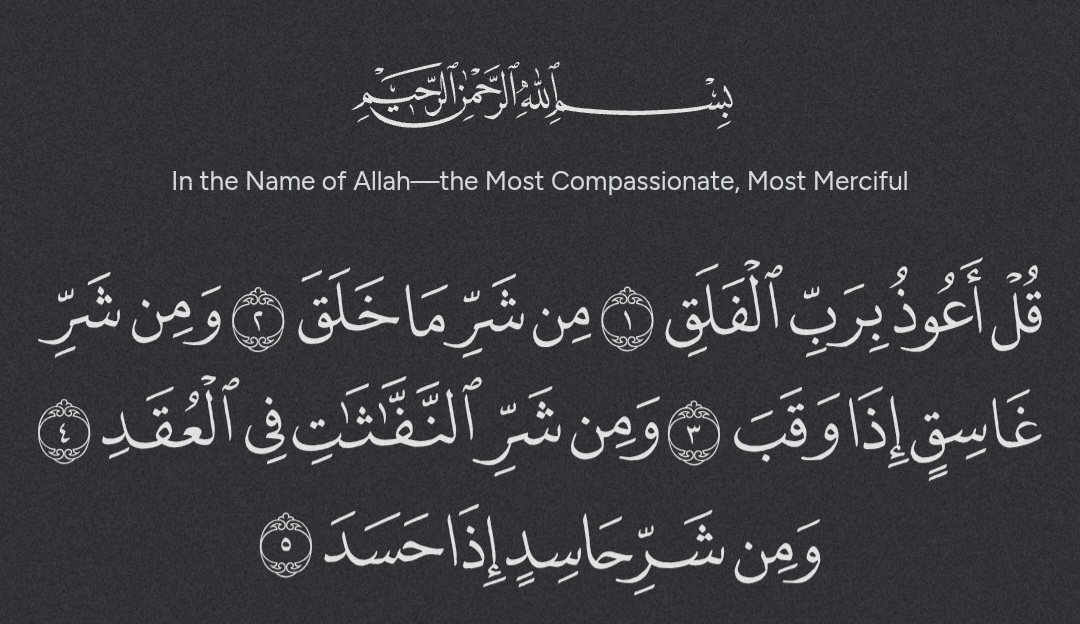
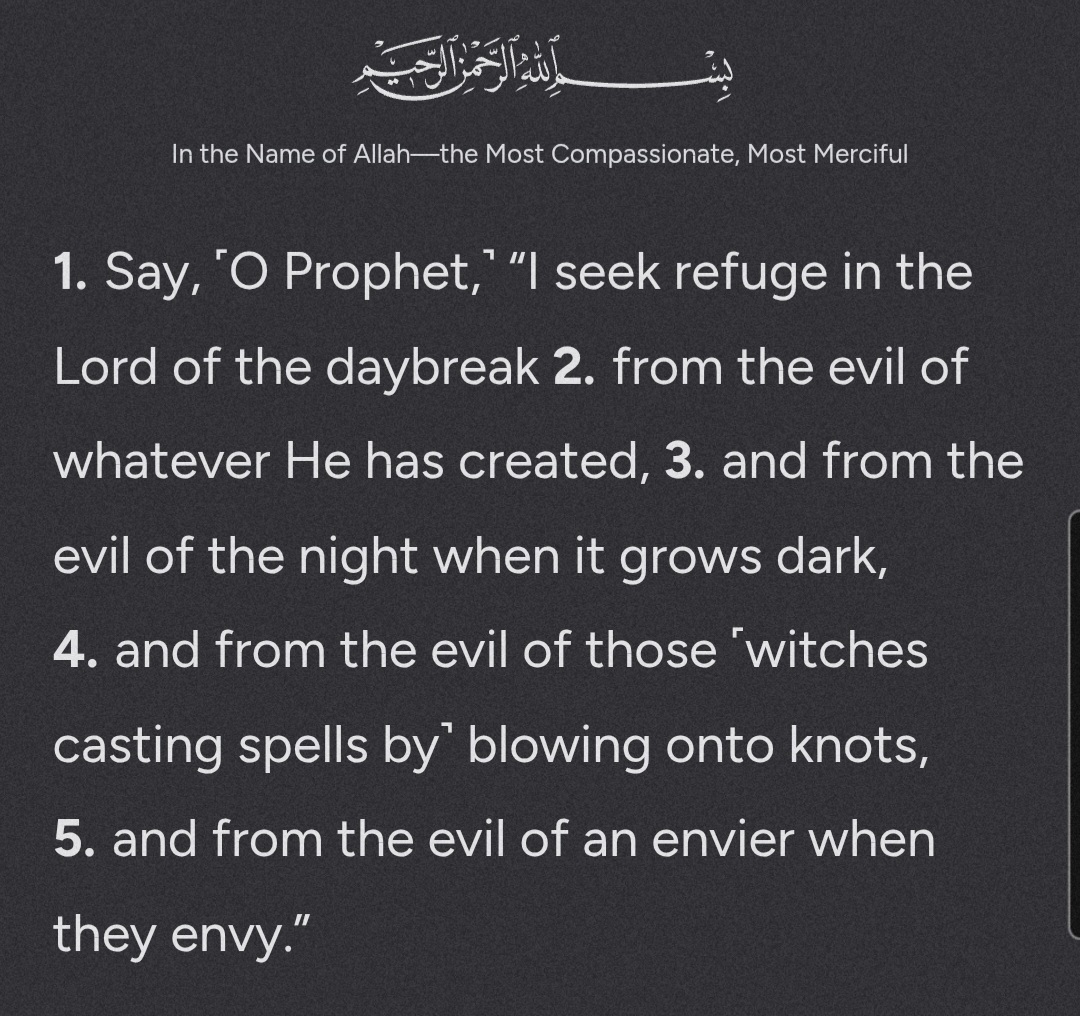
and translates into
Surah An Nas
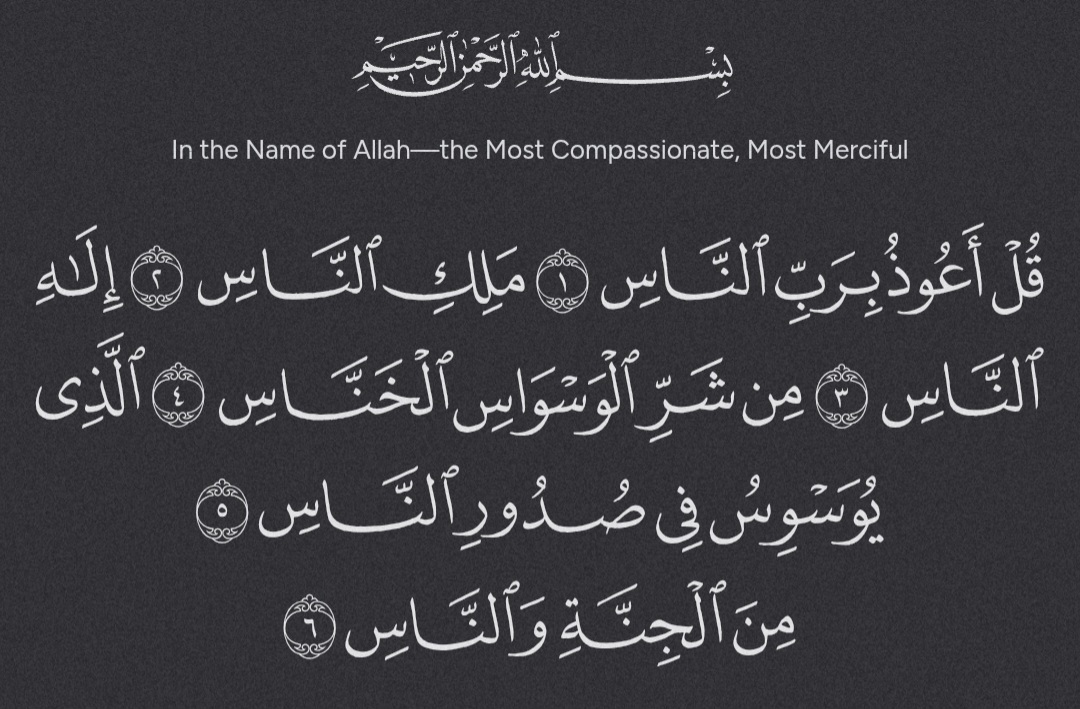
which translates into
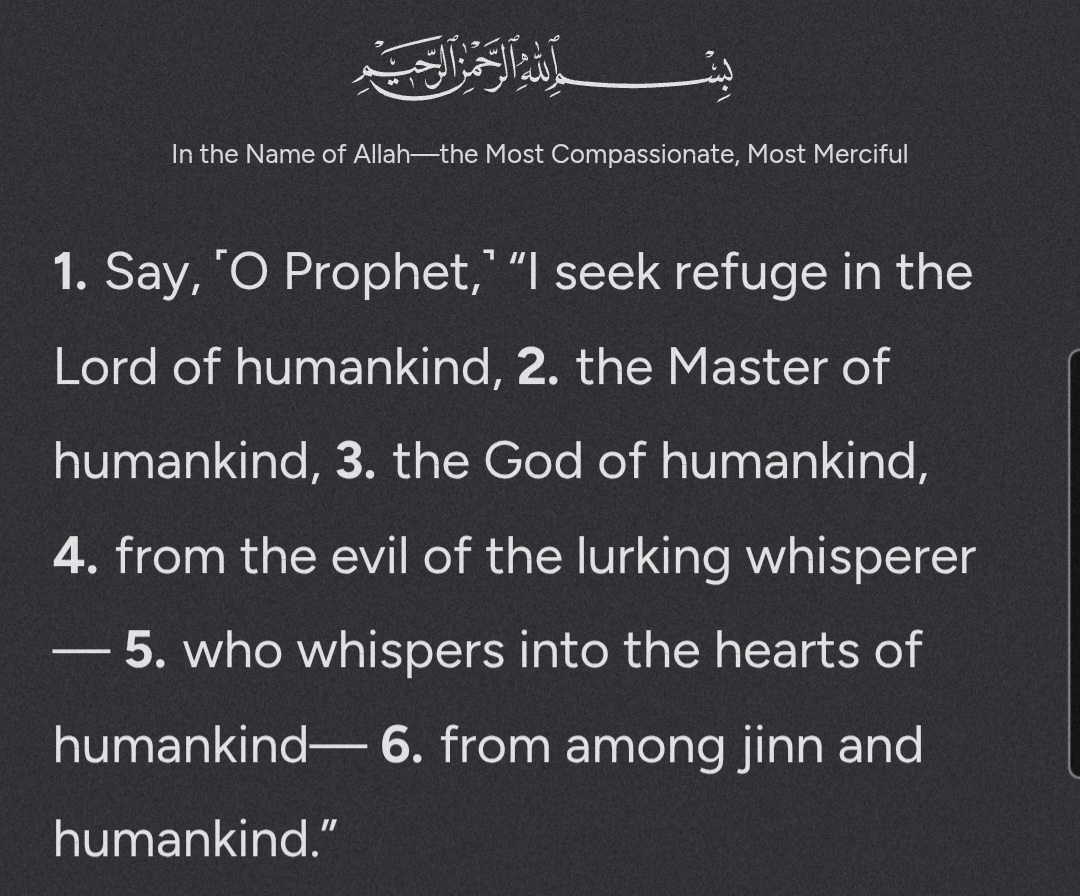
We seek refuge from the evil of knot blowers, enviers and the lurking whisperer.
Another very important supplication is recited as follows:
أعوذ بالله السميع العليم من الشيطان الرجيم، من همزه ونفخه ونفثه
Which translates into:
I seek refuge in God from the accursed devil, from his puffing up (nafkheh), his magic (naftheh) and his evil suggestions (hamzih).23
Nafkhihe means the arrogance that the devil can cause in a person which makes them wrong the people around them.
Nafthihe means ‘sputtering’ literally, but is used to denote working magic by sputtering on knots.
Hamzihe means the madness the devils can cause from obssessive thoughts to evil urges and ideas too.
Remember that intention is key. When supplicating to Allah, be mindful of the supplications and verses and their benefits. Visualize his protection forming an aura around you and everything you regard as precious. Have deep faith in the words and faith in Allah’s wisdom and mercy. Hold on to courage by knowing Allah controls everything even the evil doers. Any evil done is not done unless he wills it. Always practice thanks, for Allah says in Surah Al Baqarah, verse 23:
Remember Me; I will remember you. And thank Me, and never be ungrateful24
Praise be to Allah. Alhamdulilah for everything.
To conclude, the domains of faith and folklore often intersect and Islam does not deny the presence of wind magic. Rather, it actually lends credence to some of the folkloric beliefs and accounts mentioned in this essay.
- https://historygreek.org/ideology/anemoi#:~:text=Worship%20and%20Cults%20*%20Minor%20Deities:%20While,Anemoi%20for%20favorable%20winds%20or%20weather%20conditions. ↩︎
- The Magical Control of the Wind. Sir James George Frazer (1854–1941). The Golden Bough. 1922. Accessed on the internet http://www.bartleby.com/196/13.html ↩︎
- The Magical Control of the Wind. Sir James George Frazer (1854–1941). The Golden Bough. 1922. Accessed on the internet ↩︎
- https://www.mauritius-images.com/en/asset/ME-PI-8817038_mauritius_images_bildnummer_09286414_a-sixteenth-century-woodcut-showing-a-magician-in-finland-selling-a-rope-with-three-knots-to-a-merchant-captain-if-one-knot-is-loosened-the-sailor-gets-mild-winds-two-knots-give-stronger-winds-and-three-knots-heavy-storms-the-crew-of-the-sinking-ship-in-the-background-have-not-believed-in-this-magic-and-have-loosened-the-third-knot-olaus-magnus-%2528october-1490—august-1-1557%2529-was-a-swedish-writer-and-catholic-ecclesiastic-he-is-best-remembered-as-the-author-of-historia-de-gentibus-septentrionalibus-%2528a-description-of-the-northern-peoples%2529-printed-in-rome-1555-a-work-of-folklore-and-history-this-illustration-titled-%2522on-wizards-and-magicians-among-the-finns-%2522-is-from-book-3-chapter-16 ↩︎
- The Magical Control of the Wind. Sir James George Frazer (1854–1941). The Golden Bough. 1922. Accessed on the internet ↩︎
- The Magical Control of the Wind. Sir James George Frazer (1854–1941). The Golden Bough. 1922. Accessed on the internet http://www.bartleby.com/196/13.html ↩︎
- https://www.shakespeare-online.com/plays/temp_1_1.html ↩︎
- https://myshakespeare.com/macbeth/act-1-scene-3 ↩︎
- https://myshakespeare.com/macbeth/act-4-scene-1 ↩︎
- https://www.margauxscorner.com/post/storm-witchcraft#:~:text=Wind%20magic%20emphasizes%20the%20force,the%20energy%20to%20the%20wind. ↩︎
- https://www.meer.com/en/70295-wind-in-traditional-chinese-medicine-movements-of-energy#:~:text=In%20Chinese%20medicine%2C%20pathogens%20are,the%20pores%20of%20the%20skin. ↩︎
- https://healthqiacu.com/blog/why-women-should-stay-warm-ancient-wisdom-backed-by-traditional-chinese-medicine#:~:text=Growing%20up%2C%20many%20Asian%20women,issues%2C%20and%20chronic%20digestive%20problems. ↩︎
- https://www.meer.com/en/70295-wind-in-traditional-chinese-medicine-movements-of-energy#:~:text=In%20Chinese%20medicine%2C%20pathogens%20are,the%20pores%20of%20the%20skin. ↩︎
- https://sunnah.com/tirmidhi:1978 ↩︎
- https://sunnah.com/ibnmajah:3727 ↩︎
- https://sunnah.com/muslim:899c ↩︎
- https://www.google.com/amp/s/www.islamweb.net/amp/ar/fatwa/74605/ ↩︎
- https://www.alsiraat.vic.edu.au/news/islamic-tradition/prophetic-teachings-during-strong-winds ↩︎
- https://hadithanswers.com/reciting-surah-falaq-and-nas-during-inclement-weather/ ↩︎
- https://quran.com/al-falaq ↩︎
- https://quran.com/an-nas?readingMode=arabic ↩︎
- https://sunnah.com/mishkat:817 ↩︎
- https://quran.com/al-baqarah/152?readingMode=arabic ↩︎


 Baylassanreflections
Leave a comment